


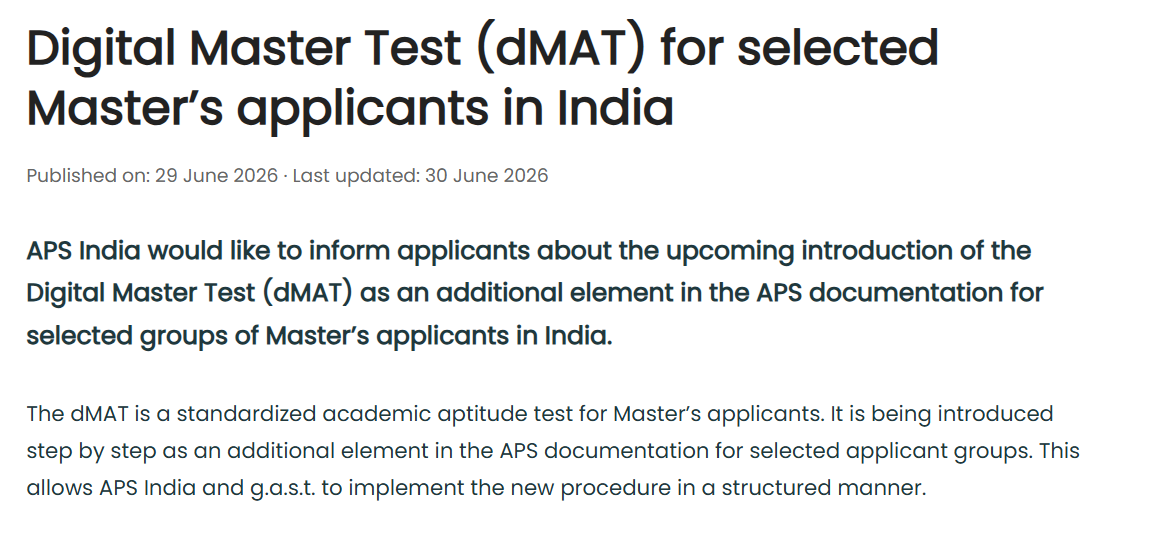
Germany has introduced a major change for Indian students planning to pursue a master’s degree. Beginning in 2026, applicants will need to take the Digital Master Assessment Test (dMAT) as part of the Academic Evaluation Centre (APS) verification process for certain applications. The new assessment aims to evaluate applicants more comprehensively by measuring both general academic skills and subject-specific knowledge. If you’re planning to study in Germany, here’s everything you need to know about dMAT Germany 2026.
What is dMAT?
The Digital Master Assessment Test (dMAT) is a standardized online assessment introduced for Indian graduates applying to master’s programs in Germany. Unlike traditional entrance exams that primarily test subject knowledge, the dMAT evaluates a student’s overall academic readiness by assessing core competencies and discipline-specific skills. The test has been introduced to strengthen the admission process and help German universities better assess international applicants.
Read More: Germany APS Update 2026: 70% in Class 12 Mandatory for UG
Why has Germany introduced dMAT?
Germany continues to attract thousands of Indian students every year, particularly for engineering, computer science, business, and data-related programs.
The introduction of dMAT aims to:
- Improve the quality of applicant evaluation.
- Standardize the assessment process.
- Measure analytical and subject-specific abilities.
- Support universities in selecting students who are academically prepared for master’s studies.
Initially, only a limited number of universities accept the test, but authorities expect its adoption to expand in the coming years.
Who Needs to Take dMAT?
The assessment is primarily intended for:
- Indian students applying for master’s programs in Germany.
- Applicants completing the APS verification process.
- Graduates seeking admission to participating German universities.
Students applying for bachelor’s programs are not currently affected by this requirement.
What Does the dMAT Exam Include?
The examination is divided into two major sections:
Core Module
This section evaluates general academic abilities such as:
- Analytical thinking
- Logical reasoning
- Problem-solving
- Quantitative skills
- Academic aptitude
Subject-Specific Module
This section focuses on the student’s academic background and intended field of study. Questions are designed to assess knowledge relevant to the master’s program the applicant plans to pursue. The exact syllabus may vary depending on the discipline selected.
Is dMAT Mandatory?
From 2026, dMAT becomes part of the admission process for eligible Indian applicants going through APS verification for participating master’s programs.
However, not every German university currently requires the assessment. At present, only a small number of institutions accept dMAT scores, though the requirement is expected to expand over time. Students should always check the admission requirements of their chosen university before applying.
How Should Students Prepare?
Although the assessment is new, students can begin preparing by strengthening the following areas:
- Quantitative aptitude
- Logical reasoning
- Analytical thinking
- Subject-specific fundamentals
- Time management
- Academic problem-solving
Maintaining strong undergraduate grades and reviewing core concepts from your bachelor’s degree will also be helpful.
Benefits of dMAT
The introduction of dMAT offers several advantages:
- More transparent admissions process
- Better evaluation of academic readiness
- Standardized assessment for applicants
- Increased confidence for participating universities
- Improved alignment between students and master’s programs
Rather than relying only on academic transcripts, universities gain a broader understanding of each applicant’s capabilities.
Documents Required Alongside dMAT
In addition to the assessment, students generally need:
- Bachelor’s degree transcripts
- APS certificate
- Valid passport
- Statement of Purpose (SOP)
- Letters of Recommendation (if required)
- IELTS or TOEFL scores (where applicable)
- Resume/CV
Requirements may differ between universities, so applicants should carefully review official admission guidelines.
Tips for Applicants
If you’re planning to study in Germany in 2026 or beyond:
- Research universities that require dMAT.
- Complete your APS process early.
- Strengthen your quantitative and analytical skills.
- Prepare your application documents well in advance.
- Keep track of official announcements regarding exam dates and registration.
Early preparation can help you avoid last-minute delays during the admission cycle.
Read More: Study in Germany After 12th: Eligibility, Top Courses & More
Final Thoughts
The introduction of dMAT Germany 2026 marks an important change in the master’s admission process for Indian students. By assessing both general aptitude and subject-specific knowledge, the new assessment aims to make admissions more comprehensive and transparent. Although the test is currently accepted by only a few universities, its role is expected to grow as more institutions adopt it. If Germany is your preferred study destination, staying informed about dMAT requirements and preparing early will give you a significant advantage during the application process.